-png.png?width=150&height=49&name=Indigo%20Logo%20_%20All%20Countries%20(1)-png.png)
By: A.J. (Ashok) Kumar, VP, Sustainability Sciences at Indigo Ag
Joan Abbott, Associate Manager, Sustainability Solutions at Indigo Ag
Joan and A.J. are back again today tackling the topic of durability, with a little help from the USDA and their white paper on soil carbon durability that was published last year.
There are many reasons to invest in soil health, but when folks are investing in soil via carbon credits, they want to know how long we expect the carbon stored in soils to stay there. At Indigo, we’re restoring carbon in soils that has been lost due to human activity, so it’s a reasonable concern that it could be lost again. And when you are making a carbon claim against an emission, a durable claim is important to be atmospherically meaningful. When it comes to soil carbon durability, there are a few positions out there that overlook the nuance of the science and human behavior aspects of soil management.
The super-skeptic: Farmers will instantly stop regenerative practices once they stop being paid for it and the carbon they stored will quickly be lost again.
This statement is demonstrably FALSE.
The super-zealot: Once folks try regenerative agriculture, they will LOVE it and never go back, and we’re building super stable carbon pools that last from centuries to millennia.
This statement is also demonstrably FALSE.
The truth lies in between these two, and for programs that seek to have meaningful impact on the atmosphere, we need to grapple with that reality and put measures in place to move the needle in the right direction. We’ve worked hard to do that at Indigo at the outset of our Carbon program, but we’ve also been continuing to look at the data in our program and the larger community to keep evolving our thinking and make changes to continue to try and reduce risk and increase our accounting for soil carbon durability.
When it comes to soil carbon durability in agriculture, there are actually two distinct areas to investigate:
-
Socio-behavioral durability of soil health practices
-
Biophysical durability of soil carbon if soil health practices are discontinued
The USDA white paper looks at both of these areas and concludes that the risk of disadoption of practices is low (i.e., most producers will continue if they’ve done regenerative practices for several years); no-till and reduced till are particularly sticky practices over time. It also evaluates biophysical durability and concludes that intermittent tillage (e.g., once every 5–10 years) is not expected to cause significant loss of accumulated SOC.
White papers like this one are important independent analyses for the potential of regenerative agriculture to have durable impact on soil health and carbon stocks.
A quick aside: Climate-Smart Agriculture vs. Regenerative Agriculture
This paper provides some really accessible background information on how changes in soil organic carbon (SOC) stocks from implementing practices like shifting from intensive tillage to reduced‑till or no‑till, and adopting cover crops, can help address atmospheric greenhouse gas buildup.
In the paper, they label these practices as “climate-smart.” At Indigo, we categorize these as regenerative agriculture practices. We use "regenerative" because it emphasizes the biological outcome: regenerative practices are specifically designed to rebuild soil organic matter and restore degraded biodiversity, turning the soil into an active tool for carbon removal.
Now let’s dive into more detail on the two aspects of durability that the white paper addresses.
Topic 1: Socio-behavioral aspects of soil health practice persistence
USDA White Paper Finding: National trends and longitudinal survey data show that once regenerative practices are integrated into a farm's operations, they exhibit high levels of persistence.
National trends show that regenerative practices, specifically cover crops, reduced till, and no-till, are spreading across US agricultural land. Between 2017 and 2022, US farmers increased cover cropped acres by 17%.[1] Cover crops are grasses, legumes and other herbaceous plants that are not planted for harvest. Rather, they are planted in between the harvested production crops in rotation. When cover crops’ stalks, leaves, stems and roots decompose, they increase soil carbon and stimulate microbe activity. And soil carbon loss is mitigated, because cover crops improve soil aggregation, stabilizing the soil surface and preventing erosion and runoff from causing carbon loss. Cover crops are more effective at doing all this in some landscapes than others, and farmers need to optimize planting, termination, the choice of plant species, and other management strategies. But this 17% increase signals that farmers recognize the benefits of cover crops and are increasingly confident in their ability to manage cover crops for long-term soil health.
Reduced till and no-till are also becoming more prevalent practices. USDA estimates that the majority of acres growing the major commodities of field corn, sorghum and soybeans are under reduced or no-till practices2. Reduced and no-till acres are creeping upwards; between 2017-2022, farmers transitioned 756 thousand acres to no-till (equivalent to a 1% increase of no-till acres). This is important, because reducing or eliminating tillage minimizes soil disturbance. Conventional tillage is used for a number of reasons - loosening and aerating topsoil, mixing residue into soil, destroying weeds mechanically, drying soil before seeding. But intensive tilling has a greater risk of soil compaction leading to consequences like less water infiltration, lower root growth, high N2O, and erosion, leading to higher CO2.
Not only do national trends show that regenerative practices are increasingly being adopted, but the data show that farmers are persisting with these practices over time. Regenerative practices reap the most soil health benefits when they are consistent over time. And nationally representative USDA data show that reduced tillage and no-till have relatively high levels of short-term persistence. 89% of field corn acres and 79% of soybean acres in no-till systems maintained that practice for at least four out of the previous five years.
We have a decent amount of empirical evidence showing that farmers continue regenerative practices in the short- to medium-term,3 even after incentive programs cease. For example, a 2024 study found that in the Mississippi Delta, cover crops showed a 70% probability of persistence even after EQIP and CSP government contracts expired. That being said, we need more data on long-term practice persistence. These long-term studies are more expensive and harder to execute logistically, but would be helpful to add to the evidence supporting regenerative practices.
Why are these regenerative practices sticking? Farmers often see the results in physical and economic resilience:
-
Short-term (3-5 year) incentives help farmers move past the up-front equipment costs that sometimes act as a barrier to conservation tillage and the operational costs for seed that are a barrier for cover crop adoption.
-
Programs effectively bridge the "human capital" gap, helping farmers master the steep initial learning curve of new management strategies.
-
Farmers realize short-term wins of no-till, such as spending significantly less time, fuel, and effort on tillage operations
-
Over time, these practices build value through improved water retention, reduced nutrient runoff (and thus reduced spending on fertilizer to replace nutrients that were being washed away), enhanced wildlife habitats and resilience to extreme weather.
-
Depending on the species chosen, cover crops can even lead to a reduced need for chemical herbicides and pesticides.
In Indigo’s Carbon and Source programs, we focus on practices that have a positive effect on both the ecosystem and the grower’s pocketbook so that we can drive lasting impact. The USDA whitepaper shows that this approach leads to results in terms of practices persisting after incentive payments stop.
Topic 2: Biophysical durability of soil carbon if soil health practices are discontinued
USDA White Paper Finding: Soil carbon benefits from years of regenerative practices are maintained over time, even if farmers do intermittent tillage.
The fear that a single tillage event acts as a reset button for soil carbon is not supported by the data. In fact, synthesis studies and meta-analyses provide robust evidence that soil carbon storage is durable even with occasional management adjustments.
Meta-analyses show that periodic tillage every four to six years reduces soil carbon by only approximately 6% compared to continuous no-till, meaning the vast majority of carbon gains are retained. This is because no-till systems promote stable soil aggregates that physically protect organic carbon from microbial decomposition, creating an inherent resilience to occasional disturbance. When occasional tillage appears to reduce soil carbon near the surface, it typically transfers that carbon to lower soil depths rather than losing it entirely to the atmosphere. Therefore, judicious application of intermittent tillage (say, once every 5–10 years) can address specific agronomic challenges like weed pressure or compaction without compromising long-term carbon gains.
To validate these findings, the USDA utilized process-based models to simulate 30 years of management across 94 Major Land Resource Areas:
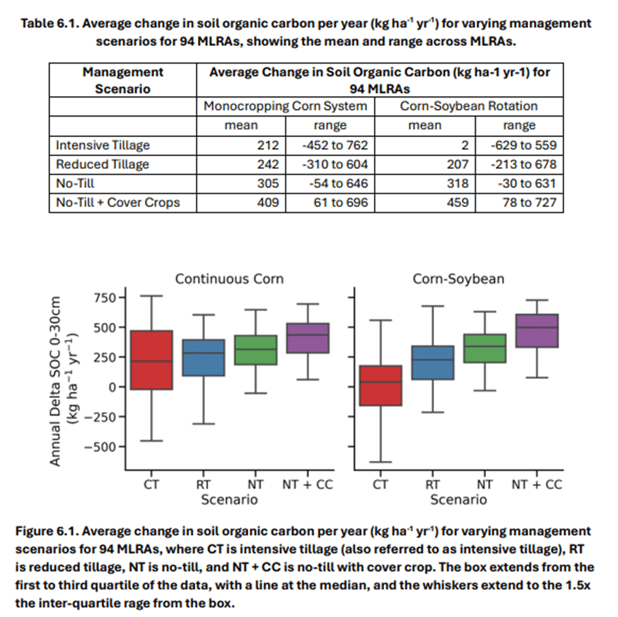
Image Source: U.S. Department of Agriculture, Documentation of CSA Practices, page 13.
Even in "extreme" scenarios—where farmers practiced no-till for three years before reverting to intensive tillage for 27 years—modeled results still showed net carbon benefits compared to continuous intensive tillage.
So is the takeaway that regenerative agriculture practices will generally persist and accumulated soil carbon will stay in place no matter what?
Nope. While there are many encouraging findings from this white paper, incentives for a few years are not enough to guarantee durability. At Indigo, our Carbon program builds multiple safeguards to protect the durability of claims made from our program:
- Choose practices that align with farmer interests in the long term: practices like cover crops, reduced tillage, and nitrogen management have varying lengths of time before benefits show up on the field. Carbon payments provide a financial bridge until these practices become habit and become something producers can bank on in terms of operational profitability.
- Do the math and hold a reserve at the project level: Despite point number 1, growers may step out of the program. If they do, we continue to monitor fields remotely to see if they stop using cover crops or do tillage for several years in a row. With over half a decade under our belt, we can track these numbers and ensure a reserve of credits is held to mitigate reversion of practices.
- Buffer the project itself at the registry level: Even if we do our best efforts on 2, what happens if a major natural disaster (flood, hurricane, tornado, etc.) or other external event destroys fields in our program? For this, the registry Indigo works with, the Climate Action Reserve, holds a buffer pool of credits across all their programs and monitors for reversals to then make sure that buyers can remain confident in the credits they have purchased.
Outside of these three mechanisms and the findings of the USDA paper, we continue to investigate ways to improve our project and advance the science. For example:
-
What mechanisms would reduce the risk of development of agricultural land, especially during generational transfers?
-
Apart from the impacts of intermittent tillage, what are the impacts on soil carbon of disadoption of cover crops or crop rotations? We expect these to be lower impact than tillage but exact rates are hard to come by in the existing literature.
At Indigo, we don't operate in a vacuum. Analyses like this USDA white paper provide an independent reference, ensuring our scenario designs and durability buffers reflect the latest peer-reviewed evidence. These insights help us align our soil carbon modeling with the broader scientific consensus and the rigorous standards expected by registries and stakeholders.
By avoiding falling into either the skeptic or zealot traps, we can focus on what the data say about current levels of practice persistence and biophysical durability of soil carbon, and we can work to further improve it with good program design and further research.
References:
U.S. Department of Agriculture. (2025). Documentation of literature, data, and modeling analysis to support the treatment of CSA practices that reduce agricultural soil carbon dioxide emissions and increase carbon storage. Office of Energy and Environmental Policy, Office of the Chief Economist.
1Note: all stats are taken from USDA’s Documentation of CSA Practices, unless otherwise noted.
2The white paper cites, “35.6% of field corn acres in 2021, 58.8% of sorghum producer acres in 2019, and 44.8% of soybean acres in 2023 were in no-till. An additional 39.9% of field corn acres, 16.7% of sorghum acres, and 35.9% of soybean acres were in reduced tillage.”
3That being said, we need more data on long-term practice persistence. These long-term studies are more expensive and harder to execute logistically, but would be helpful to add to the evidence supporting regenerative practices.